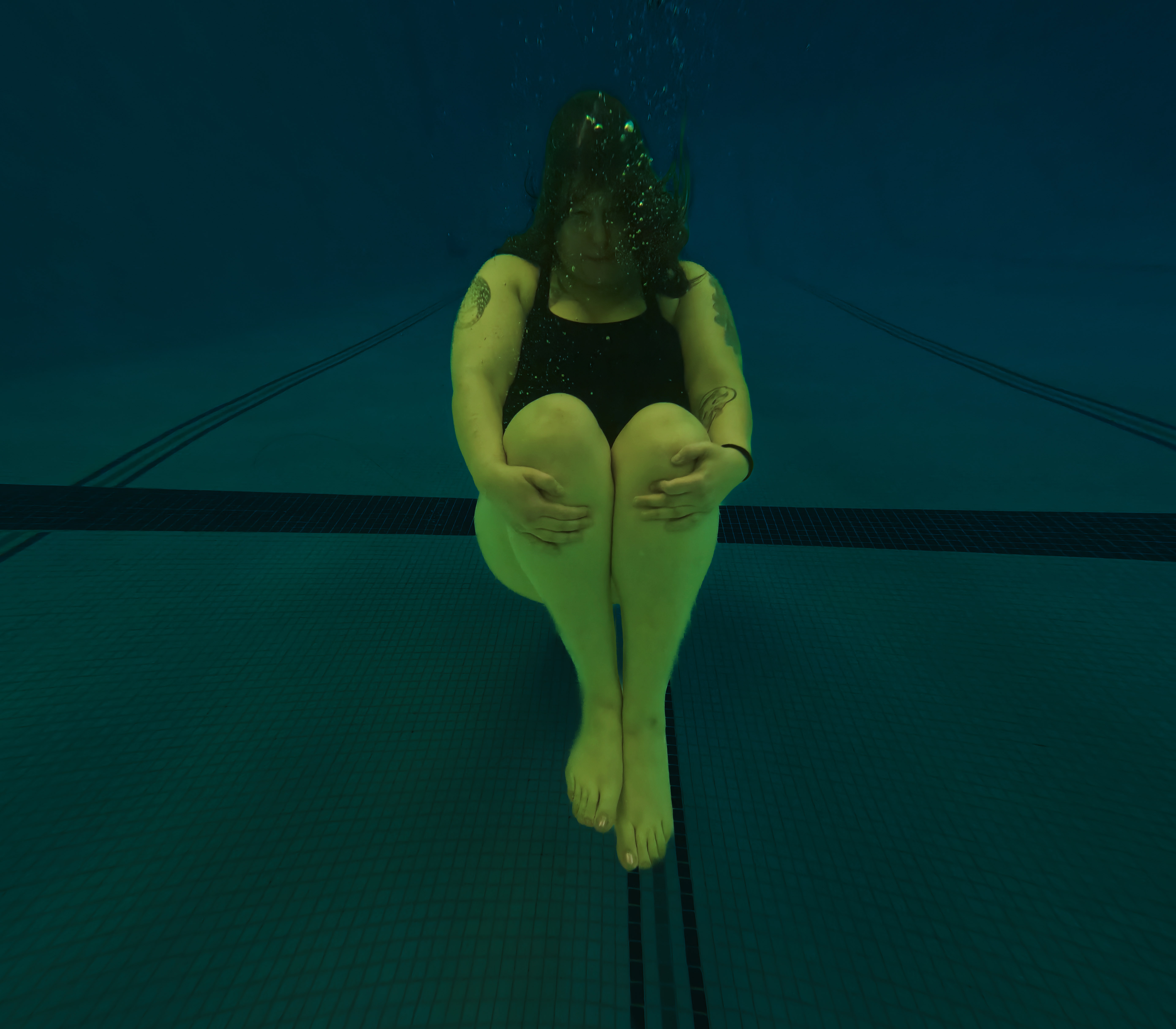
There is a difference between thinking and what happens in the body when language falls away.
I first encountered this difference as a child, when I nearly drowned while swimming in a lake. The experience was not dramatic. It was physiological. The body reorganizes around breath. Speech becomes unavailable. Everything narrows to orientation and survival, but there is also a terror that resists language.
After that, my mother enrolled me in a summer swim league. The swimming lessons I had taken were clearly not enough, in her view. The goal was simple: I needed to become a stronger swimmer.
At first, I resisted it. The structure felt imposed: early mornings, drills, repetition. Over time, I improved. Correction gave way to measurement: times, endurance, incremental gains. I became the most improved swimmer on the team. Improvement produced its own logic.


I wanted to be better. I began swimming year-round. The structure expanded to fill everything: early mornings, evening practices, dryland training. The body was organized around repetition and endurance. Time was measured in intervals and small drops. Swimming became a daily system, one that trained the body to sustain effort, to regulate itself, to continue.
Over time, I internalized a particular logic: that effort and worth were inseparable. That discipline would lead somewhere definite. That repetition would accumulate into something like transcendence.
That framework eventually broke down. The outcomes I had imagined did not materialize, and the years in the water began to feel less like a trajectory and more like a closed system—self-sustaining, but not necessarily leading outward.
I left the water for a long time.
I have been returning to it recently. The familiarity is immediate but incomplete. The body remembers certain rhythms, but not all of them. There is a gap between recognition and capacity. This return is not about training or improvement. It is not oriented toward outcome. It is a way of re-entering a space that once structured my thinking, but now operates differently.

In the water, everything reorganizes around breath. Timing becomes the primary structure. You measure duration rather than distance. Thought does not move forward. It condenses and repeats—counts, fragments, small loops of memory. There is no progression, only recurrence.
The paintings I am working on now are beginning to take shape from this experience. They are less concerned with describing a figure and more with registering a state: how the body holds itself under pressure, how perception narrows, how orientation shifts when breath is limited. Figures emerge and recede within fields that feel less like environments and more like accumulations of sensation.
Swimming is not expressive in the way that language is. It is regulatory. Breath, rhythm, and repetition organize the body without the need for articulation. I am interested in how this internal system might function as a structure for the work.
There is also a relationship between this experience and other forms of sustained attention. The work of holding something together—whether a body in water or a set of relationships over time—depends on repetition, maintenance, and a kind of quiet persistence. It is not dramatic. It is continuous.
The water no longer represents a measure of achievement or a path toward something else. It is not a site of progress or failure. It is a condition—one that reorganizes the body and thought in specific ways.
The work is developing slowly. For now, I am trying to stay close to the conditions that produce it: water, breath, repetition, and the space where language recedes.